
Sex Offender Checks in Jackson County
The official starting point is the ACIC Sex Offender Registry Search. The Arkansas Crime Information Center manages that public system under the Department of Public Safety. It can narrow an Arkansas search to Jackson County, a city, a ZIP code, or an address and radius when those controls are available. A name is useful when the person is known. Place filters are more useful for community awareness near a home, school route, park, or family destination.
The Jackson County Sheriff's Office has a different role. It handles local registration at 615 Second Street in Newport and routes compliance questions by phone at 870-523-5842. The sheriff does not replace the state public search, and the registry does not replace a Jackson County court file. Before relying on a match, compare aliases, physical details, address information, offense data, registration status, and the date of the last update.
Jackson County residents do not need a paid name-based background check to use this public-safety tool. The ACIC registry is free and record-specific. ARCH, the Arkansas State Police name-check product, serves a different purpose and charges a fee. Search ARCourts likewise displays public court case information rather than current registration status. Choosing the right system prevents a court charge, an old conviction, and a current registry duty from being mistaken for the same thing.
Jackson County Sheriff Registration
Registration is an in-person law-enforcement function, not merely an online listing. The Jackson County Sheriff's Office services page lists sex offender registration and a $250 fee. The sheriff's office is at 615 Second Street, Newport, AR 72112. Call 870-523-5842 before a visit to confirm what identification, documents, payment method, and appointment steps the office currently requires.
Jackson County Sheriff's Office
615 Second Street
Newport, AR 72112
870-523-5842
Registration and compliance routing
That local registration counter and the ACIC database serve linked but distinct purposes. The office receives or verifies information under Arkansas requirements. ACIC publishes the portion that state disclosure law makes public. If a profile appears stale after a move or other change, note the profile details and contact the sheriff rather than confronting the registrant.
The services page is the verified local source for the listed fee, but it does not publish a detailed online registration form or office schedule. Calling first is important. Ask what the fee covers, whether payment is due at the visit, and which documents the office needs. Those procedural facts can change, and the public registry result itself does not answer them.
How to Search the Arkansas Registry
ACIC's search is the primary official lookup for Jackson County sex offender records. Start broad enough to catch spelling variants, then narrow carefully. An empty name search does not prove that no public entry exists. A person may use an alias, the spelling may differ, the address may have changed, or disclosure may vary with the assigned risk level.
- Open the official ACIC registry and read its conditions and misuse notice before searching.
- Enter a name, or choose Jackson County and add Newport, Tuckerman, Diaz, a ZIP code, or an address filter.
- Review the result list without assuming that a shared name identifies the correct person.
- Open the profile and compare aliases, physical traits, location, offense, risk level, status, and update date.
| Field Label | Type | Required | Notes |
|---|---|---|---|
| Name | Text | No | Search a known registrant; try supported spelling or aliases. |
| City | Text or select | No | Use Newport, Tuckerman, Diaz, or another locality. |
| County | Select | No | Choose Jackson County when the option appears. |
| ZIP | Text | No | Narrows results to a postal area. |
| Address and Radius | Text and select | No | Supports proximity searching when available. |
| Search / Clear | Buttons | N/A | Runs the search or resets the entered fields. |
Place searches and name searches answer different questions. A place search shows public entries tied to the selected area. A name search tests a specific identity. Neither should be treated as a promise that every registered person is displayed in the same way.
For a city-focused check, try the city field first, then broaden to Jackson County if the result is too narrow. ZIP boundaries and city names do not always describe the same area. An address-and-radius search can add nearby results when the interface offers it. Clear the prior fields between search methods so an old filter does not hide a relevant entry.
Jackson County and NSOPW
The state registry is strongest for an Arkansas-focused search. The National Sex Offender Public Website adds a cross-state layer when a person may have moved or when a safety check spans more than one state. NSOPW draws from participating jurisdictions, so it is a search gateway rather than the Jackson County registration office.
The national portal view below illustrates why a second official channel can help when a search reaches beyond Arkansas. It should be followed by a check of the source jurisdiction's own profile and current contact information.
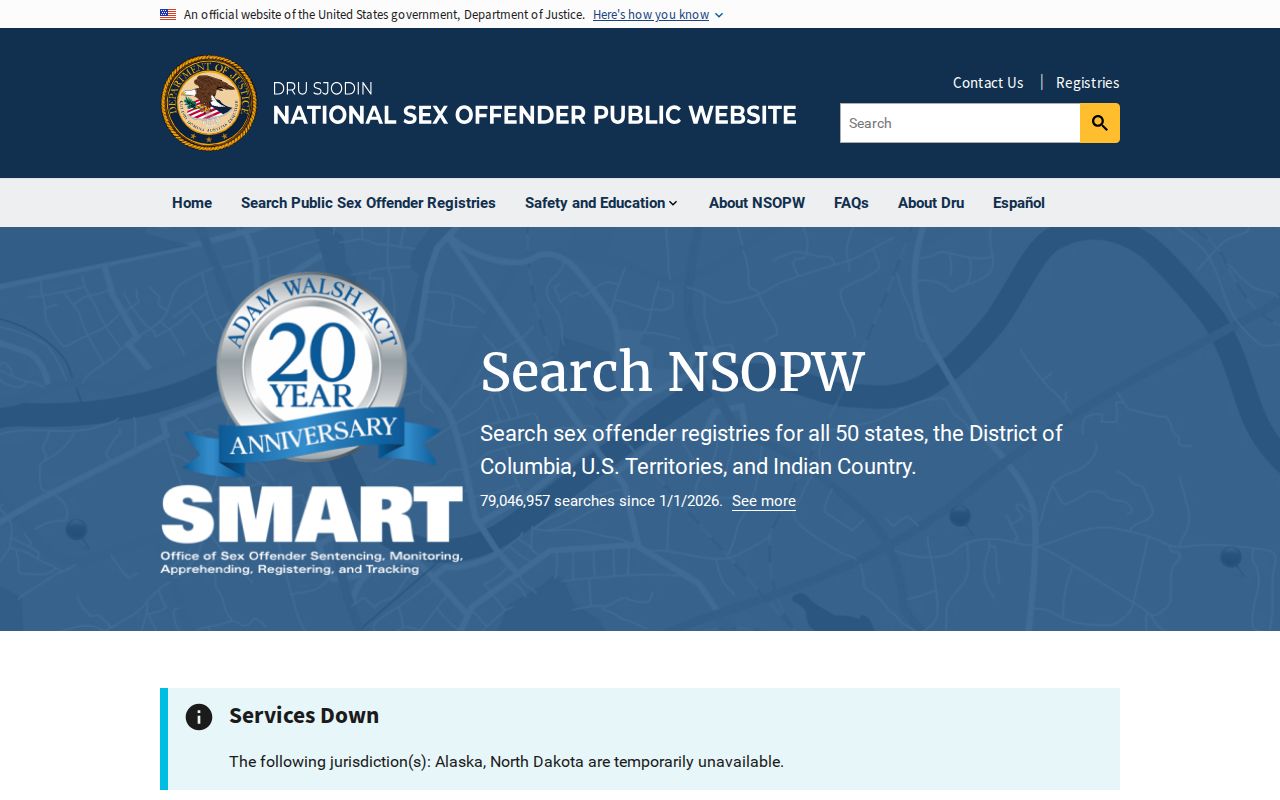
For a Jackson County address or compliance issue, return to ACIC and the sheriff. Those offices maintain the relevant Arkansas registry and local registration channels.
NSOPW is especially useful when a known person recently arrived from another state or when a family trip crosses state lines. It does not make state records identical. Each source jurisdiction controls its public fields and update process. Open the source profile behind a national result, review its date, and use that jurisdiction's official contact for questions outside Arkansas.
Inside a Jackson Registry Profile
A public profile combines identity, status, risk, offense, and location fields that disclosure rules permit ACIC to show. Read the whole record. A photograph or name alone is not enough for a sound match, and the listed address should be read with the update or verification date. Some fields vary by profile and level.
| Name & Aliases | Primary registered name and other public names used for matching. |
|---|---|
| Photo & Physical Description | Photograph plus public traits such as sex, race, height, weight, hair, eyes, and age or birth data. |
| Registered Location | Address or mapped location as allowed by the applicable disclosure rule. |
| Offense Information | Public offense, conviction date, and jurisdiction details when displayed. |
| Risk Level | Arkansas assessment level from Level 1 through Level 4. |
| Registration Status | Compliance status, registration agency, and last verification or update information. |
| Other Public Details | Vehicles, school or employer data, marks, scars, or tattoos when disclosure permits. |
Registry offense text is not the full court docket. Pleadings, orders, sentence terms, and later case events belong to the clerk's file. Readers who need that procedural history can use the county's criminal court case search routes and verify documents with the court that handled the case.
Status terms deserve equal care. A profile may show a compliance condition, registration agency, or verification date, but that short field does not disclose every contact between the registrant and law enforcement. Likewise, a mapped point should be interpreted according to the registry's own location description. ACIC, not a private map, is the source to consult when a field needs clarification.
Why Jackson Profiles Differ
Arkansas does not publish every registrant in one uniform way. ACIC describes Level 1 as the lowest risk and Level 4 as the sexually dangerous predator or highest-risk category. Public access and community notification increase across that range. The absence of a field on one profile does not mean that the field is missing from every underlying law-enforcement record.
Profiles can also change after a move, a compliance update, reassessment, or removal after the applicable statutory period. Compare the displayed status and last update before acting on the information. If an address or status appears wrong, preserve the public profile details and report the concern. Do not try to verify an address by approaching a listed person or household.
This difference in visibility is a feature of the Arkansas disclosure system, not evidence that one Jackson County search is broken. Level 1 notification is generally limited. Levels 3 and 4 support much broader public notice. Level 2 sits between them. Because level, offense, and statutory duties are case-specific, a result list should never be used to infer the full count or makeup of every person subject to registration in the county.
Arkansas Registration Levels and Requirements
Arkansas assigns four risk levels that shape public visibility and notification. The research does not support one fixed registration term or verification schedule for every person. Duration depends on the controlling statute and offense, while public notice depends in part on the assessed level. Verify a case-specific duty through ACIC, the sheriff, and the governing record.
| Arkansas Level | Public Meaning | Duration and Visibility |
|---|---|---|
| Level 1 | Lowest assessed risk; notification is generally limited. | Term depends on the offense and statute; public visibility is limited. |
| Level 2 | Moderate assessed risk. | Case-specific term; more community notice than Level 1. |
| Level 3 | High assessed risk. | Case-specific term; broad public access and stronger notice. |
| Level 4 | Sexually dangerous predator or highest-risk category. | Case-specific term; highest notification category. |
The ACIC sex offender information page is the official source for current level explanations and disclosure guidance. Contact the Jackson County Sheriff's Office for local registration procedure rather than guessing from the public profile.
Risk level and registration length are also separate concepts. The level describes assessed risk and affects notice. The governing offense and statute determine how long a duty lasts. The available research does not establish one countywide verification frequency, so no fixed schedule should be inferred from the table. A person checking their own duty should obtain case-specific direction from the sheriff and qualified legal counsel.
Report Jackson County Noncompliance
Suspected noncompliance belongs with law enforcement. Record the profile name, the displayed status, the page's last update, and the specific fact that appears inconsistent. Then contact the Jackson County Sheriff's Office or the local police department. ACIC is the statewide registry channel when the concern involves publication or state registry data.
Keep the report factual. A late-looking update may have an explanation that the public page does not show, and only the responsible agency can check the underlying file. For an urgent threat or an emergency, use emergency services. Routine registry questions should go through the sheriff's listed office number.
If the concern arose in Newport, Tuckerman, or Diaz, local police can receive immediate local safety information, while the sheriff remains the county registration contact identified by the research. ACIC can address the public system itself. Giving the office a clear location, time, and profile reference is more useful than offering guesses about motive or legal status.
Note: Reporting a clear concern to officials protects safety without risking harassment, mistaken identity, or interference with an active compliance review.
Jackson Registry and Court Records
A registry profile, a criminal case, and a background-check result are three separate Arkansas records. ACIC's registry answers whether public registration information is available and shows the fields allowed by registry law. Search ARCourts shows public docket events from courts using the Contexte system. The Jackson County Circuit Clerk holds circuit documents, including filings and orders that may not be downloadable online. ARCH produces an Arkansas criminal-history result through Arkansas State Police.
Those sources can differ without one being false. A court docket may describe the conviction and sentence but omit a current address. A registry profile may display the assessed level and verification date but not each motion or later order in the court file. An ARCH result follows criminal-history dissemination rules and is not designed as a neighborhood map. Updates may also reach one system before another.
Use the record that fits the question. For current public registration status in Jackson County, start with ACIC. For the history and outcome of a circuit prosecution, use Search ARCourts and the circuit clerk. For a person's own official Arkansas criminal-history product, follow Arkansas State Police instructions. When two records seem inconsistent, note the identifiers and dates, then ask the office that owns the disputed field to verify it. A registry status question belongs with ACIC or the sheriff; a judgment question belongs with the court.
Community Notification and Lawful Use
Registry information supports personal, family, and community safety. Arkansas law controls what may be disclosed, and ACIC's level system affects the breadth of notice. A responsible Jackson County sex offender search uses the data to understand a public listing, plan safe routines, or bring a concrete concern to the proper office.
Ark. Code Ann. 12-12-913 governs registry disclosure and publication. Public access does not grant permission to threaten, intimidate, harass, retaliate, or commit another crime. It also does not turn the registry into a substitute for a certified court record or an official background-check product.
Use Registry Data Lawfully: Misusing registry information to harass, threaten, intimidate, retaliate, or commit a crime is unlawful. Arkansas registry disclosure is governed by Ark. Code Ann. 12-12-913.
When a profile affects a safety plan, use official facts and current dates. If a listing seems incomplete, contact ACIC or the sheriff. Direct action against a registrant or household can harm innocent people, compromise a lawful inquiry, and expose the person taking that action to criminal consequences.